Thursday, January 19, 2017

terrible conditions in the mountains

There is forecast for warmer days soon but Befana has delivered a double shock of weather and more earthquakes to Le Marche. We made bookings last August to stay in San Severino Marche for two months from now. None knew that the intervening months would produce such disruption to life, earthquakes August and October, now more, with terrible weather conditions for those displaced.. I read the local paper daily, we have a real sense of attachment and concern. Here from today's Il Resto. Even in adversity the language is poetry:

Earthquake: shocks without stop, the people are in the street. Fear at Macerata and in the whole province. Some schools evacuated to the coast. Earthquale and snow, the people of Macerata are on their knees. Photos...


Tuesday, January 10, 2017

and into culture!

source http://www.italialiberty.it/mostraartdeco/
We find that in Forli there will be an interesting exhibition of art deco 'Anni Ruggenti' - the roaring years - there are links from that page to other things to see nearby.

This a city more noted (and less visited) for its rationalist architecture. Being the big town next to the small town (Forlimpopoli) where Mussolini's mum lived, substantial investments were made in the 1930s in modern urban design and technology including the flight school where Mussolini's son attended. A complex background. But a real ongoing interest in the modern.

Source http://www.simonesimone.it/forl%C3%AC-razionalismo/
This offers a glimpse of the architecture and commentary on rationalism.

And here is a whole list of places of interest in Forli. See also my earlier blog entry on Forli.

In Mantova, we arrive just as the winter chamber music season at the Teatro Sociale is ending. We have booked for the last night performance by the Mantova Chamber Orchestra, 1 April. Online booking easy, pick up tickets with ID and receipt at the box office... unlike booking for the opera house in Rome. The program was not of extreme interest and they offered only to post tickets to us for forty euros. No thank you.

The Mantova Teatro Sociale is a lovely sized theatre a 300 metre walk from our apartment.

source: http://www.teatrosocialemantova.it/

Here from youtube a nice little film from a performance in the theatre, pleasing to hear what they think of Mantova and audiences in this theatre.


----

In Rome, there seem to be a number of possible entertainments in the week before easter including Bach mass away over town from our apartment in the great Accademia di Santa Cecilia

We have opted for an event near our apartment, in the Great Hall (Aula Magna) of the University of Rome, a duo performance of violin and cello by two musicians, Brunello and Carmignola, whom I saw described somewhere as the Al Pacino and Robert de Niro of Italian music. They go on from Rome to perform together at a charity evening in Treviso, a rough googly translation about them and about that here. 

Violin and cello only, no orchestra, fascinating.  

For both Mantova and Rome, we booked using vivaticket as initially directed from the Teatro Sociale booking office person, Giulia, and that led us to Rome options.

In Rome, in Monti, we may well be able to follow the sound of music down the street. ... Of course we did that in Guanajuato two years ago to find our ancient front door refused to open again... a good case for ensuring you don't go out with absolutely nothing in pocket and with your basic travel info at a cloud location. We had the coins for an internet cafe, found the document with the manager's number, parked at google drive, we rang the manager, she got us a hotel room for the night and a locksmith in the morning... all was not lost.)

Here is an old photo of the Aula Magna, from the web. This is about 2km from our apartment. 

source http://www2.uniroma1.it/musa/images/index/07.jpg


Thursday, January 5, 2017

La Befana

from the Urban Dictionary
In Christian belief the 'epiphany' as celebrated on 6 January or adjacent Sunday marks the date on which Jesus's status was stated to the Three Wise Men.

In Italy, it is referred to in everyday language as La Befana, easily seen as a pronunciation of the Greek 'epiphany'.

The wider use of epiphany is as in the text box screenshot from the Urban Dictionary.


La Befana in Italy entangles with folk legend in that Befana is there held to be a woman who failed to respond promptly to the request of the wise men to chip in some gifts and follow the campaign trail. Realising her folly, discovering the guys had gone ahead, Befana assumed a role of rushing about, dusty from chimney arrival-departure, giving children gifts (on the goodness-wickedness scale) on the night before the day celebrated as Befana. Wikipedia has a nice account of this. As does a Canadian Italian organisation from which this image is drawn. In this way, Italians have had a female figure like Father Christmas for a long time, arriving this far after Christmas. Babbo Natale is just a kid, having entered Italian minds in the post war period. These days of course the Wise Guys would have registered a tax exempt charitable fund, I suppose. But Befana is not real, whereas charitable organisations should be.

This year Befana brings arctic winds from the east, finally harsh winter and snow in and extending from the Appenines, as seen in this shot from a weather forecast page.


Thursday, December 8, 2016

Train from Mantova to Rome

The new Trenitalia timetable dropped the direct Mantova–Roma Termini Frecciargento high speed train. Replacing it with slow regional options to Bologna or Milan to connect with the mainline Frecciarossa services.

Italo Treno, the private competitor on just a few lines offers better than Trenitalia from Bologna to Rome on the day in question, Friday 7 April.

So we will travel regionale  to Bologna, as at left (the price is for two). Then we will leave our bags safely at the station and briefly visit downtown Bologna before taking Italo to Rome. I bought two of the low cost first class (Prima) seats on advice of the Man in Seat 61, because there is
in each carriage, one set up with two seats facing each other across a table. Replacing arguments about window seat with arguments about riding forward or riding backwards. I think if you get the facing forward seat you have clear obligation to be the one to say 'look at that' and point, because at 250km/hr there's not much point in the person looking backwards saying 'look at that'.

This is the wonderful Man in Seat 61 [link] and this below is a screenshot of the two-to-a-table arrangement he recommends.


Tuesday, December 6, 2016

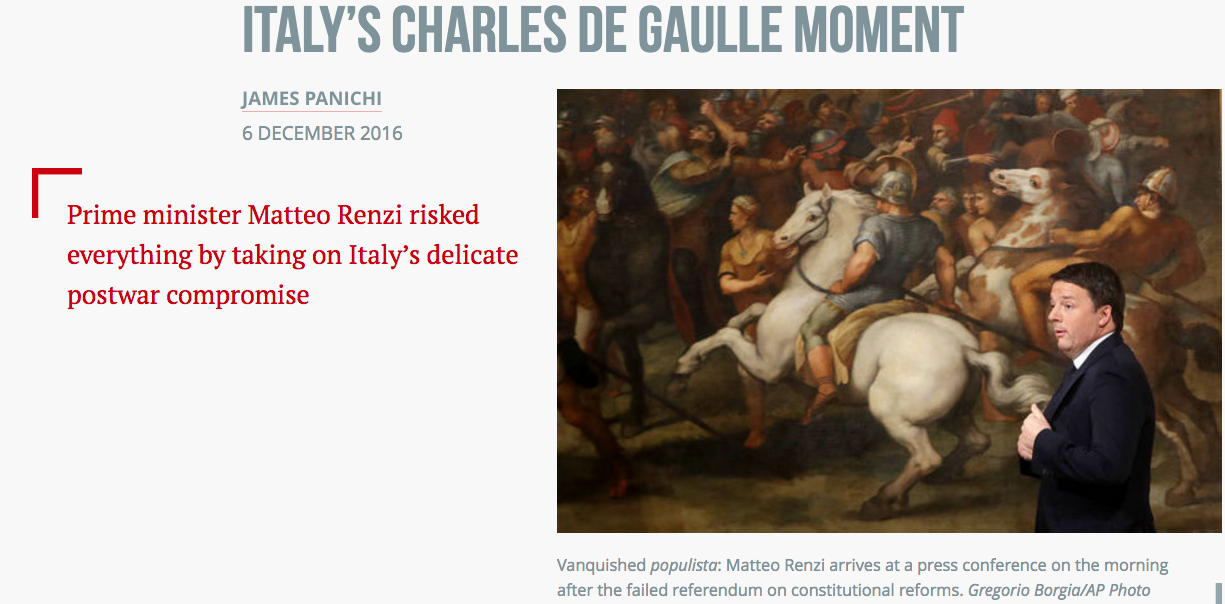
Referendum and Renzi context.

source
A referendum to amend the Italian constitution was lost on Sunday and the young prime minister Matteo Renzi who had, unlike all before him, gotten reform that far, resigned in the face of dinosaurs on all sides wanting him gone.

There is an excellent review of the situation here, by the Australian born, Italian citizen, head of the Brussels managing editor of MLex, James Panichi.

The Italian constitution vests significant powers in the president and President Mattarella is a very experienced politician who entered politics when his brother, at the time President of Sicily was assassinated by the mafia. Asked then to clean up the Sicilian branch of the Christian Democratic Party (DC). He was a member of the left in the DC, a concept difficult for those coming from countries where a catholic party would be expected to be deeply conservative. But the Democristiani were working in a different kind of world, where it as the confessional party contained within itself everyone from monarchists, fascists, conservatives to socialists and anarchists. The old DC regularly securing 40% of the vote to the Communist Party's 30%. Mattarella's faction favoured the 'apertura alla sinistra', opening to the left, and dealing with the communist party.  He seems held in warm regard. He has told Renzi to stay in his seat and sort out budget and electoral laws. Mattarella is not rolling over for the right and populists calling for an election straight away.

-----------

For non-Australians seeking the meaning of the "Renzi’s Keatingesque strut" this is a reference to the wonder-modernist spit-on-fools former Australian Prime Minister Paul Keating, who also took on too many people at once, including a conservative electorate.

Sumptuary

I think the Oxford Dictionary is wrong in saying this is a seventeenth century word, right in contrast to other sources in not limiting meaning to moral or religious grounds.

There are valuable texts, links here and here (and in the right column) for discussion of sumptuary laws in medieval and renaissance Italy.

These also make the interesting point that Italian cities and towns (Italy just a notion and a bit of geography back then) differed from other places in Europe; they saw the development of a middle class earlier than other parts of Europe. In referring to cities I note that at the time of the renaissance Florence had the same kind of population as my small town in Australia (30,000 - 40,000).

In that situation, sumptuary laws evolved to limit wicked expenditure on non-necessities and especially imported goods, trading cities having a rather Trumpian notion of trade, push it out, stop it coming in. Already a bit upper class people who would prefer to kick away the ladder than help others up to their elevated level. Dr Seuss wrote a book, King Looie Katz, and more about it.

There was church-tut about décolletage and more of course.

At the beginning of her honours thesis, Amanda Facelle writes:
Fashion and luxury were very important in Italian Renaissance society.
One’s appearance indicated more than whether one was simply attractive, it also
indicated one’s social standing. It was commonly believed that if one could acquire
the wealth and means through which to buy beautiful clothing and host bountiful
feasts, one could rise in status and prestige. Since most of the societies of
Renaissance Italy were relatively fluid, at least compared to other societies of the
time, the prospect of upward status mobility by the middle classes through
luxurious clothing and opulent public behavior was troubling to the upper echelons
of society. The more people infiltrated their ranks, the more their power would
become diluted. They would not have this, if they could help it. How was this
problem to be solved? The answer, in part, lay in the adoption of sumptuary laws.
There follows a very interesting account, worth the read but long and thesis-style, including of the velocity of new laws to catch up with new efforts to beat existing laws.

Facelle [p 24] writes
Numerous cities also imposed fines upon those who acted contrary to the established law. Often times, ladies would simply wear what they wanted and expect to pay the fines that they knew they could afford. This phenomenon was so prevalent that it was even given its own term by the Venetians,“pagare le pompe,” or “to pay the luxury fine.”
In those times, according to such reports, women wore impractical shoes to make clear that they did not have to work.

But now we read in the Medical Daily that academics claim that certain shoes are worn to manipulate men. They probably did not expect to have an accompanying photo of so much more than shoes. People are apparently paid for this research:
According to a recent study published in the journal Archives of Sexual Behavior, women who wear high heels are found to be significantly sexier to men. ... The first three studies involved a woman confederate wearing black shoes with no heel, a 2-inch heel, or black pumps with a 3.5-inch heel asking men for help in various circumstances. The woman switched shoes after soliciting every 10 people.
I am distracted.

Nancy Lamb Roider writes:
The Italian noble class was a highly fluid group. Nobles in other parts of Europe were easily identified, as they lived off rents and other feudal incomes, and fought based on the requirements of knight service, rather than for money. The lifestyle of Italian nobles resembled that of their counterparts only in passing, for the Italians were frequently only glorified merchants [or successful gangsters according to Templeton, see earlier blog entry]. Most of the people who will be discussed in this paper come from the merchant stock; they or their immediate forefathers worked for a living for at least some part of their lives. This history of work led new Italian nobles of the late Middle Ages and Renaissance to feel somewhat illegitimate. These feelings of illegitimacy were manifested in the perceived need to proclaim their status whenever possible. These feelings gave rise to the ostentatious fashions...
source
Aha, you say, I know those people, they are all around me in the modern gossip magazine, with also some efforts just to have fun. But underneath all, the desire to be sumptuous. Or cheerfully ludicrous.

source
We have, at minimum, subconscious rules about where people should wear such.

It is possible to observe class differences (real or imagined) in assessing those photos from this link.  ... acceptable on a racecourse in spring, in Australia.

People write to TripAdvisor asking what is the dress code for Italy in April. To which the reply generally is "there is none, but be respectful in churches, some have rules."

Morality and politics come into play in modern times too.  As these images indicate:
source
source


Saturday, November 26, 2016

Communication, syphilis, Este and culture.

Some years ago at the Porta Portese market in Rome (though not quite as long ago as the engraving here might suggest) I bought a version of Ptolemy's map of 'Southeast' Asia which had been a fold out frontispiece of the French edition of this history by the Scots historian William Robertson, name too long to type. The original published in Edinburgh in 1791, the French edition in 1792. I liked the map, for itself, but also found it intriguing that in a moment when France was busy with the guillotine and Britain and France were going to war knowledge, wisdom, academic literature moved so swiftly.
We don't hear about Robertson but "Robertson was a founder member of Edinburgh’s Select Society in 1754 along with David Hume, Adam Smith and Allan Ramsay and supported the establishment of the Royal Society of Edinburgh in 1783." [source]

source Amazon

Now, in reading Rita Castagna Mantua, History and Art, Firenze 1979 pages 24 and 26, I read that Francisco II and his son Federico II Gonzaga, Marquesses of Mantova, both died of syphilis.

Wikipedia reports that too, alleging also that the entirely philanderous Francesco contracted it from prostitutes while the son 'inherited it from his father'. [source] [source]  Were Francesco here he would probably sue Wikipedia for suggesting he had to pay.

Lucrezia Borgia, blamed for everything in those years that could not be precisely pinned on her brother Cesare and her dad Pope Alex 6, died aged 39, also in 1519, the record showing death caused by childbirth difficulties. But the record also shows that inter alia Francesco and Lucrezia had a long term raging affair.

Come back to them in a moment. First I want to note that the dominant theory is that syphilis entered Europe with the return of Columbus in March 1493 from his first voyage to the Caribbean.

Then, quick as you can publish a French translation of a history published in Scotland three hundred years later, the armies of Charles VIII of France carried syphilis to Italy and most notoriously to Naples. But as that last link indicates he stopped along the way with quite a bit of customary rape and pillage. That link also brings into focus all the families of the period in Rome and northern Italy. There is mention in particular of the Sforza family, ruling in Milan. I wrote earlier of Caterina Sforza of Forli, bastard child of her role model the dreaded Gian Galleazo Sforza.

source wikipedia
His younger brother Ludovico Sforza was in charge by the time Charles VIII came by, ally in one direction, not in the other, check how the wind blows from Rome. Interesting how these families alternate raging monsters with cultured people with imagination. Ludovico and his sister married a brother and sister Este, from Ferrara, in a joint ceremony orchestrated by Leonardo da Vinci. Leo also splashed some fresco on the wall adjacent to Ludo's dad Francesco's tomb. Not many people go to see Frank's tomb but a crush of people go to see the Ultima Cena - Last Supper. The historical context is often lost in the tourist rush for Big Things.

Easily distracted ... my point was to draw attention to the turmoil of the times and this other dimension of the times, not only a proliferation of printing presses in Italy but also of syphilis. But it seems ridiculous to pin the rampaging, soldiering Francesco Gonzaga's syphilis on the sex industry when he was an archetype of the rape and pillage industry. Nobody of course (or that I've seen) writes about same sex lifestyles of the armies of the renaissance. Though at court there must have been a bit and one suspects that the great idealised poet Torquato Tasso, tolerated especially in Ferrara, may have been a bit queer.

For more on sex in the renaissance try this search.

source wikipedia
Francesco Gonzaga married Isabella d'Este, the Ferrara family of culture and style. I mentioned the Este court in Ferrara before as an end note to discussing the Gonzagas at Mantova. Now I realise that in both courts, the great civilising and artistic patrons were Alfonso II and his sister Isabella, the Estes. Though I earlier suggested that Alfonso's wife Lucrezia Borgia may have been influential in the shaping of Italian language, not least as while known for her affair with Frank Gonzaga, she also carried on some horizontal correspondence with the towering figure of Italian literature Pietro Bembo an owned administrator at the Este court of Ferrara.

Isabella outlived Francesco II Gonzaga by twenty years, dying the same year as her beloved, sensitive, artistic and not-very-good-at-obligatory-war-stuff son Federico. Of whose death wikipedia claims he 'inherited' syphilis from his father. It's not genetic, of course, it's sexually transmitted. Isabella showed no signs. Dad must have introduced his son to it some other ways, perhaps in shared experience, perhaps more directly? I have no background as a historian, but if people are going to leave around such nonsenses as the prostitute and inherited claims, surely I can raise questions.

I commend to you Rita Castagna's book Mantua, History and Art which led me on this expedition through the wild side of the renaissance.


Makes you realise how tame Shakespeare's take on Italy is. Perhaps he had to keep it tame to stay out of prison in fusty England. I note Anthony Burgess's speculations on Shakespeare's syphilis.